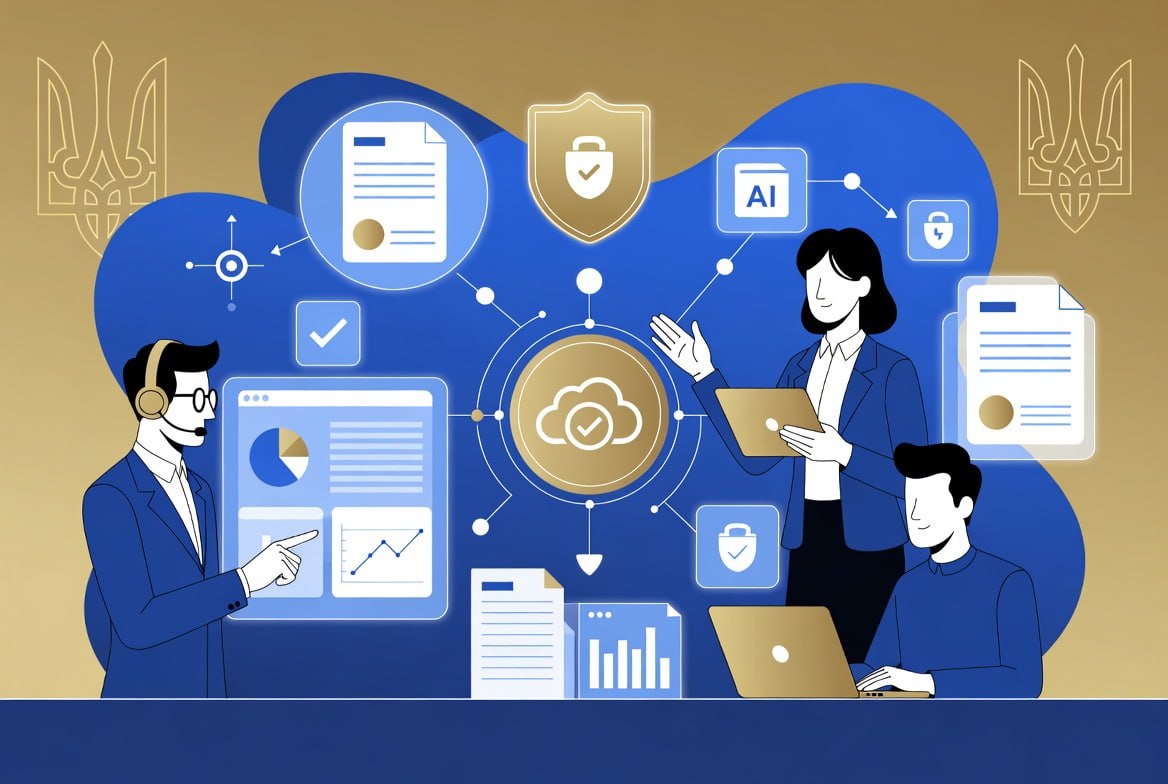
Over the past decade, accounting outsourcing in Ukraine has evolved from the concept of an “external accountant” into a fully managed financial function. Businesses no longer hire a person — they delegate processes, responsibility, and control.
In this article, we explore how client expectations have changed, the role of technology, and why outsourcing has become the new standard for accounting services.
“Accounting is no longer a function. It has become a service.”
Ten years ago, accounting outsourcing in Ukraine was often seen as a compromise — an “external accountant” for small businesses, primarily used to reduce headcount and costs.
Today, the landscape is fundamentally different.
By 2026, accounting outsourcing has become a managed financial function that integrates accounting, tax, technology, risk control, and management reporting.
The market has undergone a deep transformation — and this explains why outsourcing is no longer an alternative, but the new standard.
2015–2018: From freelance accountant to structured processes
In the mid-2010s, the Ukrainian accounting services market was highly fragmented:
- dominated by sole practitioners and small firms
- accounting built around one individual
- manual, paper-based processes
- limited documentation and standardisation
- control based largely on personal trust
At the same time, businesses were rapidly evolving. Service companies, IT firms, and e-commerce were growing, while international clients and cross-border payments became more common.
Accounting could no longer remain local and manual.
This period marked a gradual shift:
- from individual → process
- from paper → digital tools
- from reactive accounting → controlled financial function
2019–2021: Remote accounting becomes the norm
The COVID-19 pandemic accelerated changes that had been building for years.
As businesses moved to remote operations, expectations of accounting services changed significantly:
- electronic documents and e-signatures became standard
- physical presence lost relevance
- demand increased for transparency, deadlines, and structured communication
This was a turning point for the market.
Clients began to buy not an “accountant,” but a service with clear rules:
- what is included
- who is responsible
- what the timelines are
- how quality is controlled
This is where the concept of Accounting as a Service began to take shape.
2022: War as a point of no return
The full-scale war in 2022 became the most serious stress test for business financial functions.
It exposed the weaknesses of traditional accounting models.
For many companies, outsourcing became not a matter of choice, but of business continuity.
During this period, outsourcing stopped being associated primarily with cost savings. Its core value shifted to:
- stability
- rapid recovery of processes
- regulatory risk control
- access to a team, not a single individual
2023–2026: Outsourcing as a full financial function
Today, Ukrainian businesses expect far more than basic compliance and reporting.
Modern accounting outsourcing includes:
- verification and control of primary documentation
- tax and regulatory support
- payroll and HR administration
- management reporting (cash flow, P&L, plan vs actual)
- integration with banks, CRMs, and payment systems
- financial analytics and discipline
The market is steadily moving toward the mid-market segment, where outsourcing effectively replaces an in-house finance function.
In summary, between 2015 and 2026, the accounting outsourcing market in Ukraine has changed fundamentally: individual practices have given way to a team-based service model, manual work has been replaced by automation and standardised processes, and the “cheap” approach has transformed into a focus on reliability and risk reduction. Accounting has moved beyond local tasks and has become a support function for international business models, while reactive problem-solving has been replaced by systematic prevention.
Accounting has become part of business management, its resilience, and scalability.
Outsourcing wins not because it is cheaper, but because it:
- ensures continuity of processes;
- reduces regulatory and operational risks;
- provides access to expertise that is difficult to maintain in-house;
- adapts faster to changes in legislation and technology;
- allows owners and management to focus on business growth.
That is why accounting outsourcing in Ukraine is not a temporary trend, but a new baseline model for financial services.
How Acturon operates within this framework
Acturon builds accounting outsourcing as a managed financial function, combining:
- professional expertise,
- technological solutions,
- structured processes,
- responsibility for results.
We believe that accounting should not be a “pain point,” but a foundation for business — today and in the future.